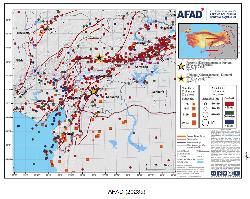
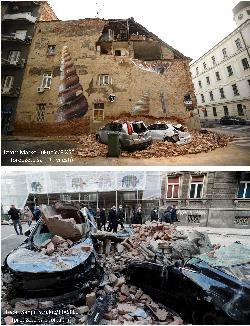
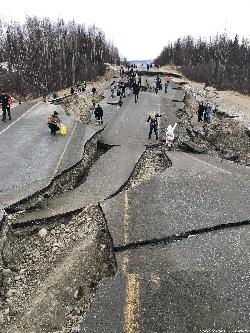
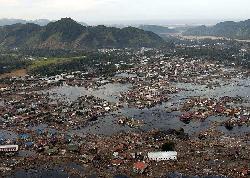
The pair of earthquakes that struck northern Venezuela on June 24 at 18:05, followed by a sequence of aftershocks, closely resembles the pair of earthquakes that hit the southeastern provinces of Türkiye in February 2023. So far, we can see that many buildings have suffered severe damage, particularly in the poorer districts of Caracas (informal settlements) and in the towns along Venezuela’s northern coast, La Guaira and Playa Grande, where the Simón Bolívar International Airport (Maiquetía) is located. Comparing the number of people affected by the earthquake in Türkiye (approximately 15 million) and in Venezuela (approximately 6 million), we may estimate that the death toll in Venezuela could range between 20,000 and 30,000, with the number of injured being five to seven times higher and between half a million and one million people left homeless. Fortunately, June 24 is a national holiday in Venezuela, so many people were outdoors attending celebrations.
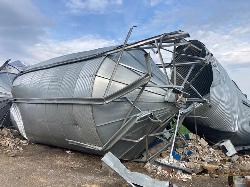
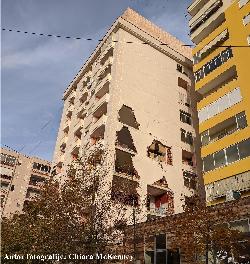
Damage to and collapse of buildings can be classified into three typical mechanisms: (1) foundation rotation caused by liquefaction; (2) failure of beam-column joints and shear failure of columns in reinforced concrete frame buildings constructed before the 1980s, prior to the introduction of modern seismic design provisions that addressed the shear deficiencies of such frames; and (3) failure of (mostly non-structural) unreinforced masonry infill walls, both through in-plane cracking and, even more critically, out-of-plane collapse.
There are still no reports on the extent of damage in Caracas’ informal settlements, but it is reasonable to expect that the informally built masonry and adobe buildings have sustained significant damage. The same applies to reports of landslides. At present, there are no confirmed reports of damage to transportation infrastructure (roads, bridges, and ports), although the damage observed at the airport suggests that substantial damage to these systems is also likely. This will hinder the delivery of humanitarian aid. Electricity and water supply networks have sustained damage, resulting in service interruptions. Mobile communication networks and the Internet appear to remain operational, most likely because backup generators at communication substations have been activated. These generators typically have enough fuel to operate for 48 to 72 hours.
The immediate priority is the search and rescue of survivors trapped in collapsed buildings. However, within approximately 96 hours after the earthquake, the primary focus will shift toward assisting the large number of people who have lost their homes. This includes the delivery of drinking water, food, and essential medical supplies, as well as the organization of temporary accommodation in tents or in larger buildings that have been confirmed safe. At the same time, structural engineers must carry out rapid building safety assessments using the red–yellow–green tagging system to provide residents with basic information about the safety of buildings that remain standing.
Once these immediate risk-reduction measures have been completed, the recovery and reconstruction process will begin. This will represent a major challenge for Venezuela. During the past decade, engineers from the Faculty of Civil Engineering at the University of Belgrade developed the RELAR methodology for the rapid estimation of repair costs and repair duration for earthquake-damaged buildings. This methodology could be applied in Venezuela. Even more valuable is the experience gained through post-earthquake field investigations in Albania (2019), Croatia (2020 and 2021), and Türkiye (2023). Members of SUZI can assist their colleagues in Venezuela in carrying out faster and more reliable assessments of damaged buildings and in selecting optimal reconstruction strategies.
More information on the following websites:
https://earthquake.usgs.gov/earthquakes/eventpage/us6000t7zc/executive
https://earthquake.usgs.gov/earthquakes/eventpage/us6000t7zp/pager
https://eos.org/thelandslideblog/venezuela-earthquakes-1
https://www.bbc.com/news/videos/c62151r0k68o
https://relar.rs/en/the-18th-wcee2024-world-conference-on-earthquake-engineering/